

A Word or Two
Jagoda is finishing her language studies, but she still wonders what she wants to “be when she grows up.” She thinks, and realizes she wants to be an artist. Of course, “artist” is a very broad term—she herself doesn’t quite know what she means by it. Recently, during her studies, she began occasionally making photos with her camera, and also drawing. Though she usually has to let the drawing “marinate” for a week or two before she can decide whether she likes it or not.
She would love to enroll in postgraduate art studies somewhere abroad. Maybe in France? The idea of studying in France came from an Instagram reel. Is that acceptable? Why not? And after her postgraduate studies, she could take a tattooing course and spend some time tattooing and making photos of cool alternatives in the streets of Normandy.
At the same time, Jagoda is convinced that if she doesn’t continue with a master’s in language, her professor might find a way to bring the guillotine back into use and then publicly behead her in the city square.
During her studies she drew, but in fact, alongside her language studies, Jagoda also began to write. And she developed a different approach to writing: she writes rarely, though she wishes she did it at least once a week. When she convinces herself to write something, she usually likes the words on the page. Is she proud? Possibly. But that’s only one possibility.
On another front, she thinks she’ll only find true peace if she goes to Italy to study the language and achieve what she always tells everyone she will: finish linguistics studies and become a translator from Italian. That’s a perfectly respectable profession, isn’t it? As a bonus, her professor would be proud of her for life.
So, Jagoda wants to be both an artist and a linguist. She often ponders this conflict. Perhaps “the best of both worlds” would be to go to France to study art? Some people (for reasons unknown) insist that Italy makes more sense for art. But she likes l’esthétique of studying in France…
Like most (self-declared) artists, Jagoda sometimes talks to herself. A whole monologue begins to recite itself in her head. And today, this ordinary Saturday afternoon, Jagoda sits on the veranda of her weekend house on Mount Vodno, watching her grandfather’s five little goats jump around the yard, and remembers one particular person from her life. She sinks deep into thought. “I have so much to tell you,” she says to herself. “You’re not even aware. How strange: when someone is constantly in your life, you don’t value them as much. Now that you’re gone, only now do I realize I should have told you about all those banal moments. About my attempts at drawing, which stubbornly look like artistic misery. About failed exams. Completely irrelevant. What matters is: now you’re not here to listen. But the blank sheet of paper is. And the cat.”
Ah, the cat. Black and gentle like a warm spring night. But now it’s afternoon, and the cat rubs against Jagoda’s legs on the veranda at Vodno. Jagoda sits with a comically large pencil in her hand, staring at a sheet of paper and thinking. Absorbed, she unconsciously sketches a faint, tiny “Ч)” on the paper. It cuts into her: her father comes to mind.
After a shocking series of personal tragedies, one autumn four years ago, while in Toronto, he took his own life. Then there was the funeral, also in Toronto. No one tells you that when your father dies, you’ll get a call saying you need to join a Zoom meeting for his funeral. Even though you hadn’t seen him for five years. Strange, isn’t it? Jagoda still has many unclear feelings about it all. She feels she must express herself. She wishes she could make it. But for now, she only holds the pencil in her left hand (she, like many artists, is left-handed) and thinks.
“I want, to begin with, to apologize for my approach to you,” she considers writing, jumping straight in medias res. “I hope you understand why I behaved the way I did. I felt a little angry, sad… simply unpleasant. When a person has all those thoughts in their head and isn’t ready to face them, disorder arises. I think only now, after all this time, I’m more prepared to look those thoughts in the eye and at least speak to them. I don’t have to fully accept them.”
Jagoda is alone with her cat on the veranda, but she knows he can hear her when she speaks to him. He is here somewhere, with her all the time. Present in his own way. Or perhaps she only feels that presence because she is wearing his blue checkered shirt, the one he gave her before he moved out?
“Well then, let me look my thoughts in the eye,” she says, glancing now at the blank sheet of paper, now at the clear sky above Vodno. “I’m aware of my actions, and that’s why I want to apologize. Maybe an apology is needed, maybe not—but just in case, I want to apologize.”
Jagoda watches the little goats nibbling at the acacia in the yard. There is one white one, with black spots. That one is her favorite. Its name is Mani. Short for “Dalmatian.” Jagoda stares at Mani and wonders: does the goat know what an apology is, what forgiveness is? Has it ever asked, in some language incomprehensible to us humans, forgiveness from its father-goat?
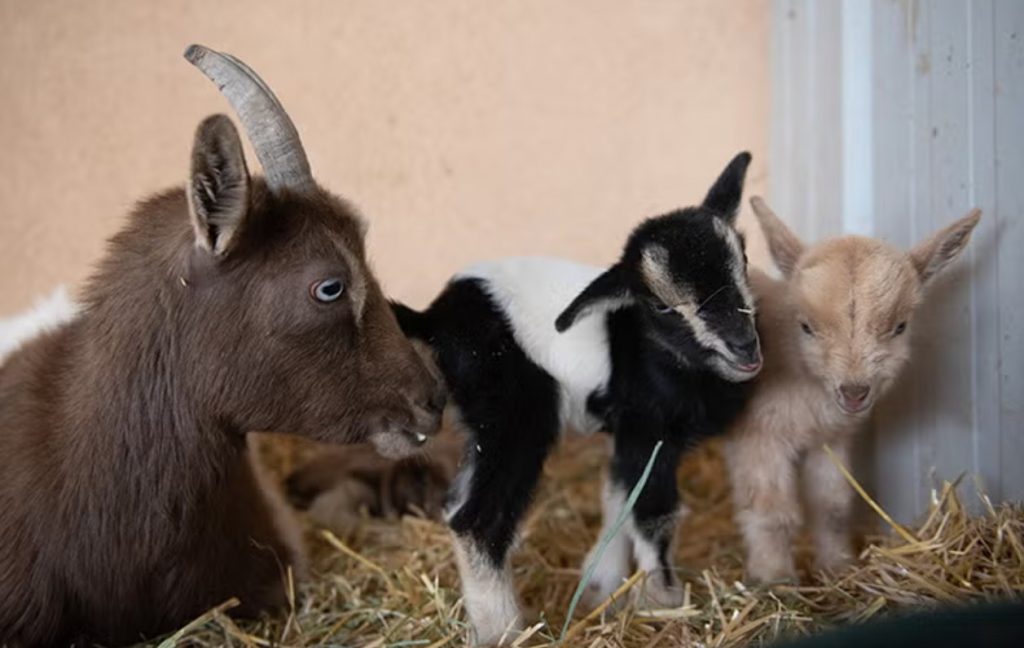
“Do you understand me?” Jagoda feels the urge to ask for confirmation, even grows anxious for a moment. But she quickly calms herself. “Yes, I believe you understand me. Even though I don’t know if I understand myself… In any case, it would be nice for me to hear a word or two, to put myself into balance. Often, when I’m asked ‘How are you?’, the most honest answer would be ‘Well, I don’t know—strange.’ But of course, I don’t say that, of course I say ‘Great, and you?’ If I say ‘strange’ to describe my feelings, then I have to justify it. I think the nature of that feeling is such that I can neither justify nor explain it. It’s just strange. Everything is strange. You see? I have so much to say…
On the other hand, I am angry, and I think I should also express forgiveness. But somehow it feels selfish to forgive you. Still, I give myself the right to be angry, yes, and therefore I thinks of my forgiveness for you. That’s how it comes to me. You did what you did, and that’s that. It happens. Maybe in some parallel universe our story is better. Your story is better. Do I forgive you? And what does it mean to forgive? Should I ask the little goats? They seem to know: first they clash horns, and then immediately it’s as if nothing happened.
I am also like them. I accept what happened. I am grateful that you were part of my life. Even if shorter than expected. I am happy that to have a life at all – thanks to you. Still, I don’t know if I understand your actions. I try. In any case, I rejoice that you taught me to have an open view toward spirituality. That’s why I sense that even now you hear me, and that you are at peace, wherever you are. I accept the present state, even though it is far from the desired one. I am aware of things, and I think that this is the most important matter. The most, most, most important.”
In the yard, darkness quietly descends, and the little goats one by one return to the small stable her grandfather built. They move slowly: tired from all the jumping in the grass.
“And now,” Jagoda continues to think, “after all this gratitude, we come to a very bad moment. To your death. And then to our approach to it.”
Jagoda glances at the sky for a moment and continues to play with the pencil. She thinks, but the sheet of paper on the table before her remains imperfectly white: alongside the faint little “Ч)” there is also the grayish imprint of the cat’s paw, which has just climbed onto the table.
This “Ч)” reminds Jagoda of the time when she and her father regularly exchanged messages: this little “mutated” smiley was their secret greeting. Jagoda sinks into thought again.
“None of us had set foot in a church for years. But when you left, faith showed itself as necessary. Because a person, as a person, must somehow make peace with death. And how did we go through it? Strange, eh. You died, and instead of marking it in some way that would truly mean something to you, we did this: churches, wreaths, candles, priests… But it doesn’t matter. You’re dead. What difference would it have made to us going for a visit to the church or going for a latte in ‘Starbucks’?”
Jagoda feels a chill for a moment, and it brings her back to the veranda. She lifts her gaze: the sky above Vodno is dark, stars are shining. She imagines her father being somewhere up there. She sinks back into thought.
“You were a Buddhist, a deeply spiritual soul. You lived in your own (perhaps better?) world. A strange mix: Georgian by father. Moroccan by mother. Yet most often you simply said Moroccan… Oh yes, and you had your own daddy issues. And for a time, you were Macedonian too. Well. However it was, you were a Buddhist — and we, after forty days, went to church. Then after six months. Then after a year. In the end, we went to mark two years. Everything went ‘by the book.’ But what a circus! First, as far as I know, in Christian faith suicide is unforgivable. Second, you were a BUDDHIST. I doubt you would have liked what we did: your closest ones going to church and slobbering all day because of your death. Literally everything you didn’t want. Worst of all, we were all together crying over something you did. Wherever you are now, in whatever version of heaven or hell, I know you don’t like this.”
The veranda in the yard at Vodno is now completely dark, the air fresh. Jagoda rises without letting go of the pencil. She glances at the cat, which immediately begins to follow her. She touches the switch by the door and the veranda is lit again. Jagoda and the cat return to the chair. Jagoda sinks back into herself.
“When you left, for months I didn’t know what was happening. It was very strange somehow. As if I wasn’t living. I just existed. By inertia. I wasn’t aware of the world around me at all. Now at least I’m somewhere around the sixth étape du deuil. Right before ‘acceptance.’ It’s too early for that. There’s time. At least I hope there is. I hope I won’t be hit by a car tomorrow. In that case there would be nothing to accept, right?
The younger me loved you very much. I can’t exactly say I don’t love you now, but it’s not the same. Still, you left. You found a new girlfriend, you told me, some Canadian. Because of that, for a long, long time I convinced myself that I hated you. But now it’s a little different.”
“Why is it different?” — a voice surprises her. Jagoda turns, but at first, she sees no one. She sees nothing, in fact: first the darkness is gone, then the cat, and soon even the veranda fades, like one of her drawings, along with the pencil and the sheet of paper on which she hadn’t managed to write even a word or two. Instead, a silhouette appears before her.
Jagoda cannot recognize the man. Only after sharpening her gaze does she notice: in an orange shirt and jeans, standing before her — her father! They are in an endless white space. Around them there is nothing. Only whiteness. And the two of them, alone. Instead of the pencil, she now holds her photo camera in her hands. She is very confused. He too seems confused. They don’t know how or why, but here they are — now. The space echoes with unrest. But can only she hear it? Or does he hear it too?
“How could you, man?!” she cries in the end. “You just left!”
“Sorry…” he replies. He looks at her calmly. As if aware of his actions, and as if only waiting for the forgiveness.
She tries to catch her breath. She doesn’t know what to say first. It’s terrifying.
“How could you do it? Weren’t you sorry for us?” she continues, agitated. He is calm. As always. Ready to answer any future question.
“There’s no need for anyone to be sorry. Believe me. Everything is fine.” She opens her eyes wide.
“Are you kidding me?” she presses on, with the same unrest. Besides looking him in the eyes, she now nervously fiddles with the camera.
“Why would I be kidding?” he insists, still calm.
“Don’t you see how we all cry for you? Don’t you feel even a shred of regret?”
He stays silent, staring at her intently. He knows she is right. But what can he do? How can he explain that he felt so irreversibly lost, so far from life, from his loved ones, from everything. So far from her! He doesn’t know how to convey that feeling of loneliness. 7,655 kilometers, across an ocean — not exactly a small distance… He sympathized with all the trapped fish. Fish tangled in a net. A net someone else had cast, and the fish happened to be there at that moment. Neither guilty nor deserving. He felt that way, or like a hamster stuck in its wheel, with nowhere left to go, no way to escape except to surrender, to put an end to the senselessness… But he never wanted them to cry. No, no, no. Unease overwhelms him, he feels the impulse to defend himself.
“Didn’t you realize by now that I don’t want anyone to shed tears? Please be calm.”
“What do you mean ‘be calm’?!”
“I don’t want tears and sadness. I want you to understand me. Just as you want me to understand your actions, I want you to understand mine,” he says. And continues: “I was glad when I noticed that ‘Ч)’ you unconsciously drew a moment ago. And I heard your thoughts too. Yes, you sense correctly: I am always here. Beside you. Well… now I have something to say.”
For a moment they look each other in the eye. He takes a breath.
“I’m sorry you didn’t tell me earlier about those ‘unimportant’ moments. I understand your anger, it’s clear to me. And yes, I understand you. I say, ‘I understand you,’ and I know how much those three words mean to you. Maybe they are the ‘word or two’ you need for balance? I long for them too. I’m sorry that after my departure you found yourself in such a state, feeling unaware of the world around you. In such a state of delusion. It weighs on me that I caused you all that anger. You know I never wanted that. Again, I only want you to understand me. Just as I have understanding, I know you do too. You are my daughter, after all…”
She is silent. Now he is silent too. In the end, she is the one who continues the conversation.
“You’re funny, you know?…” she says softly. “But this doesn’t even come close to the sense of humor I know you had.”
“Sorry Ч),” he shrugs. He smiles faintly, and then both of them remain in silence for a few moments again. Then he begins to speak, this time with an even softer tone.
“I gave up, I know…” he says. “I simply couldn’t cope with such unrest anymore. I too have my limits…”
She listens. At first calm, but quickly the feeling of lack returns, and with it again the anger.
“I don’t care about apologies, you know? I just want to know why. Please, just tell me why…”
The words, however, do not come. And in that moment, the silence seems the loudest thing of all. She cannot bear the quiet. It suffocates her.
“Are we going to stay silent now?” she cries again. Then his eyes light up.
“How about… what if…,” he stares at her intently, “I mean, is it possible that our bond wore out, that it had an expiration date, and we had to part, so that we could meet again, through your writing?”
She looks at him. This thought makes her pause. Hmm… Maybe he’s right? But she will never accept it. Never. The idea that they had to separate feels absurd to her. Nothing is mandatory, of course. Except for dying. Hmm… ironic.
“Yes,” he continues, still looking her straight in the eyes, full of confidence: “I was far from you, and you were far from me… and our communication had become conflictual, even exhausting. It’s unlikely that after everything, our renewed togetherness would have been successful. Besides, my lostness and sorrow were so tiring, so unbearable… Tell me, please: is it possible those tragedies weren’t coincidences, but orchestrated, so that both I and you could finally be at peace, truly? On one hand, let’s admit it, we’re aware that reviving our bond would have meant conflict, right? On the other hand, remember, for you there followed new ‘coincidences,’ meetings at bus stops, wearing my shirts… Maybe it all happened so that in the end we could achieve a new, deeper connection, complete self-expression and mutual understanding?”
She listens and says nothing. Silence. She knows what their previous communication was like, and all the misery that followed. Does she sense the possibility of a renewed misery? If she must admit: yes, she does sense it. Yet still— is the current absence better? She is aware that much of those five years their communication was a mess. Just as she is aware that in the last six months of his life, the conditions were such that they spoke almost daily. She is even aware that he wrote to her on March 8th, and she left the message sitting. Marinating. Like her drawings. Yes, she is somehow very aware of it. Too much, even. But would anything have changed if she had replied to that message? Should she blame herself for his decisions? Perhaps if she had answered on March eighth, now instead of talking to herself, they would be side by side? But again: would it truly have been better, essentially, for them to be side by side? And would it have been better for everyone—would peace have echoed then?
“Tell me, do you believe in coincidences?” he asks.
“I believe, I believe…” Jagoda says, turning. In the whiteness around them, she notices incense sticks. From one rises a thin thread of smoke, carrying the scent of oranges and cinnamon. “You know, that spiritual spark of mine… it comes from you.”
He listens, a smile appearing on his face. “Hey, you don’t know how glad I am to hear that… Well, what do you think, was it coincidence that you met that writer at the bus stop, back then?”
“No way,” she says, shaking her head.
“Ah, do you remember that short story, Peonies and Forget‑Me‑Nots by that Bulgarian?” he continues.
“I remember…”
“What’s the main theme? Two characters, one male, one female, perfectly understand each other, but cannot have a shared future, so they invent a shared past.”
She exhales deeply.
“I see where you’re going. Don’t…”
“But aren’t we in a similar situation?” he insists. “You and I, people who have become characters, unable to have a shared future, suddenly find ourselves in a situation to create—a shared present. And through writing! To me it’s special, even miraculous, this coincidence… Yes, doesn’t it inspire, even amaze, this healing of our unfinished story?”
She listens and thinks. Silent. The scent of oranges and cinnamon seems to fill their surroundings more strongly. She looks at him gently.
“Yes, we are in a similar situation…” she says at last. “As much as I don’t like it: we are. Well, imagine this… I miss you so much that I wrote an entire story… Thinking that through writing I could finish our unfinished tale. But, did I finish it?”
He stands and looks at her. She raises the camera to her eyes. Click! At least something to remember this last farewell by. Hmm… Last? We’ll see.
At the moment Jagoda presses the button and the flash goes off, he disappears. Then slowly, the whiteness around fades. Finally, even the scent of cinnamon and oranges vanishes.
Jagoda is once again sitting on the veranda of her weekend house on Vodno, staring at the stars, listening to her grandfather’s five little goats, still not asleep in the stable. What did just happen? She doesn’t know. She only knows she mustn’t worry about what he encountered on his way. In fact, she has a strong premonition of what he encountered. The more she thinks, the more she is filled with a sense of peace, even joy. Maybe tonight she will manage to sleep? Who knows. The five little goats will sleep peacefully—that, at least, she can be sure of.
Author of the autofictional story A Word or Two is Elena A., one of five participants in the second creative writing workshop for autofictional short stories, On the Natural Flow of Things, held in March and April of 2024. Cowriters and editors of the story are Živko Grozdanoski, the workshop’s creator, and Jagoda. The story was written in parallel with the stories Back at the Waterfall, Ashram, and The Hot Seat by Mila T., Tea P., and Bistra M. — the three other companions on the journey. The story was translated into English using Microsoft “Copilot” and redacted by Živko G.