
Back to the waterfall
Bianca cast another glance at the back seat of her car, where two drawings lay neatly wrapped in decorative paper and tied with a shiny ribbon. Then she turned and began climbing the hill above the village. She followed an invisible path through sparse bushes on the barren slope. She needed a little time for herself, wanted to be alone. Alone, but also wild and unpredictable, like this wilderness, where there were no misty fireflies of silent witnesses’ gazes. She chose the desert because it resembled her.
In truth, Bianca was troubled that she hadn’t kept up with her surroundings. She was angry that she hadn’t recognized the mockery of her pain. More precisely, Bianca was still disappointed by a conversation she had overheard between the school principal where she worked and one of her colleagues.
“Imagine, I’ve been stringing her along for a whole year, and she still continues!” the principal had said. “Is she normal? Am I supposed to be looking for computers? If I happen to look for computers after all, I’ll do it for the city kids, not for the dirty village children. I can’t describe all the things she told me about those kids: that one child limped with one leg, another was fragile in health… And what can I do, when social services don’t care for the children, leaving them at the mercy of grandparents? If they can’t take care of their grandchildren, they should put them to an institution! Imagine, I deal with hundreds of documents every day, and now I should think about her and those children too…”
Bianca was a teacher. But for the last three years she hadn’t worked in the city: every day she drove from Kriva Palanka to the small border village where she herself had grown up, and taught the only two children left in the village, now fourth‑graders. Her friend Irina, convinced she wanted to help, offered her a job in the city, but Bianca rejected any thought that would distance her from her place of origin. And from her memories.
Some of her colleagues working in different cities called Bianca “the village teacher.” But she paid no attention to their labels and continued her profession, which she never experienced as work, but as joy.
“Hey, didn’t they teach you to knock?” — a distant, yet somehow familiar voice woke her from her thoughts, and Bianca froze on the path among the bushes, wrapped in questions: who was that? She turned and saw a large, tall man with a mustache. He wore a shirt and tight trousers, “the latest trend in the fashion industry”, someone might say. But where did she know this man from?
“Where should I knock? I’m in the wilderness. And where did you appear from?” Bianca replied, closing with her coolness the door this man thought he had opened.
“Do you see the hut on the hill?” the man asked cheerfully, pointing toward a hut that perhaps existed only in his imagination.
“I don’t see it,” Bianca replied. “Anyway, I can recognize you by your voice, but I can’t recall who you are,” she added, and after a small pause took a hesitant deep breath. A cloud had hung over the barren slope moments before, but suddenly the June sun burst through the sky. Warm rays poured over her, and it felt natural to compare herself to them, though they shone mercilessly. Yes, suddenly, as if the rays appeared just for her, and she found them and claimed them.
“Eh, little squirrel, don’t you recognize me?” the mustached man called to her, moving across the nearly barren slope. Then he stopped, raised one hand, and beckoned her to follow him.
Bianca hesitated for a moment, then headed that way. Careless, she stumbled on a stone, and as if she herself turned to stone. She stumbled, but did not fall. She only knelt beside the stone. But even if she had fallen, it would have been only with her body.
When Bianca was falling with the spirit, it was only because of the children. Because of the two little ones in the village who were so poor they barely had the basics for life. Let alone computers. Todor and Igor. In a crumbling house, Todor lived with his grandmother, while in the neighboring house Igor lived with his elderly grandfather. Their parents had been best friends, but all of them died in a car accident on the way back from a wedding. A terrible tragedy.
The children’s houses were nearly falling apart, but the single beam that held them together was Bianca. She was the savior of Grandma Stojna and Grandpa Tome, because their grandchildren’s fate depended largely on her. Bianca pitied Stojna and Tome: in their old age they could no longer work the fields and were forced to buy food in meager amounts from their poor farming pensions. Bianca helped them, was always there for them, and spoke daily with them about the needs of their grandchildren. In those conversations she always admired their sacrifice, their patching together of days, barely meeting the children’s basic needs.
The children had warm meals, usually without meat. They had warm clothes, patched many times, passed down from cousins who had gone abroad to work and never returned. And what mattered most to Bianca — no matter how hard the grandparents tried, they couldn’t even dream of providing a cheap computer for the children to practice writing or play a game. Bianca herself couldn’t find a solution. She grew angry at government campaigns that on one hand declared education was power, and on the other did nothing for marginalized children.
Bianca fought these battles, though she herself barely made ends meet. She was also the mother of two sweet children — five and seven years old. Tatjana and Ivana. They lived with her in the city — the “big” city, which was so full of everything. But they were alone: Tatjana and Ivana’s father one day left, disappeared to another country. On top of that, he refused to pay child support.
Despite everything, Bianca helped her pupils as much as she could. She brought them food: what Tatjana and Ivana ate, sometimes Todor and Igor had for lunch too. Sadly, Bianca couldn’t spare much from her own children’s mouths. And when she spent more time in the village than necessary, because of snow and ice, she felt she was neglecting her own children — when lessons were held in one of the children’s houses, the grandmother or grandfather always insisted on coffee and long conversations. In the end, exhausted by worries and questions, Bianca sometimes became completely drained, and powerless, after all the floods of helplessness and rage, she felt estranged even from her own children.
Her daughters were silent witnesses to her distracted gazes. Gazes that sometimes dreamt of the stories and the events of her childhood, of the once‑famous village where she had grown up. Yet the children did not know of the greatest emptiness and pain in their mother’s heart, and could not even imagine that pain.
“Only one person ever called me little squirrel…” Bianca whispered on the barren slope, feeling a flicker of uncertainty. Before her stood the mustached man. “But with that person I slowly drifted apart, and then completely forgot him…” Bianca added, “I don’t even remember exactly what was my role in life back when I knew him.”
The man’s expression remained cheerful, but now a hint of uncertainty appeared in it too. As if his very spirit depended on her gaze and the energy radiating from it. Slowly, silence wrapped around them both. But not for long.
“It smells like incense. Do you smell it too?”
“Yes. It smells like incense.”
“Yes, like reconciliation.”
Bianca admitted to herself the unrest that tormented her and resembled the desert, and that — by some unknown mechanism of consciousness — truly seemed to bring her the scent of incense: Bianca felt calmness, a strange mercy toward herself. Along with the scent of incense, she admitted — everything was all right. It was all right that her thoughts were emptiness. Like the desert. Like the village itself, which had become a wasteland.
The village lay eight kilometers from Kriva Palanka. After the Second World War, when the authorities cared for the land, this road, like all the others, was passable. And because it was in a border region, the village had more than one privilege: amid the wildness of the surrounding mountains, it was adorned with perfectly functioning asphalt roads. But that was once. With the collapse of the Yugoslav state the border post was closed, and that badly affected the village itself: soon it was forgotten.
Dozing in oblivion, the elevated village offered a view of the lavish mountains in the distance, but also of the torn‑up road that ran through it. The neglect was most visible in the path leading to the hill: it was all cracked. The same cracks that secretly carved themselves into Bianca’s soul, gaping there as emptiness too.
Bianca fought against discouragement because of this: though together with other villagers they tried to do something, wrote petitions to the municipality to renew the road, to connect the village with the city, asked to meet the mayor… there was no result: their efforts seemed to end up in trash bins. Alongside other unread proposals from the locals. And as emigration from the village began, so too disappeared the persistence of trying to do something.
When she submitted petitions, Bianca absorbed the hated color of arrogance worn by the officials, and in the end, after all the absence of human will, “the village teacher” expressed that repressed energy in her first encounters with the mountain, turning it into cries of despair. But even that was in vain — only the forest and the wild animals could hear her helplessness. Wasn’t it true what the old villagers said, that once this hill was a magical place where miracles happened? Then why didn’t at least one miracle happen, she used to ask herself, for the road through the village to be renewed, to become passable? Or at least for the house that held the children’s school to be accessible, so they wouldn’t have to hold lessons in the children’s homes?
But the battle for the village road was an old story, already a dead fire. Now Bianca dreamed of securing at least one computer for her pupils. Of course, the children weren’t deprived of education, but they were isolated from their peers. Bianca knew that would change once they grew older and began studying in the city, but she also knew how important it was for them to keep up. That’s why she was determined to get them a computer. For months she had been pleading everywhere: with the principal, with the education sector, with the mayor, with numerous companies that presented themselves as socially responsible… But here too she met only resistance and indifference.
The greatest opposition came from the principal. She seemed intent on obstructing all Bianca’s initiatives. At first, when Bianca explained the situation of the children’s families, the principal listened and promised help. The Constitution itself guaranteed every child’s right to education, and it was the principal’s duty not to block that right, even if it was a branch school with only two pupils. Yet despite that, despite everything, the principal persistently convinced Bianca that no one was interested in the projects she wanted to achieve: neither the companies, nor the sector, nor the father of the municipality. Bianca, alas, believed her lies. Months passed, even a whole year… The principal kept finding excuses, and Bianca always had understanding and justifications for her. Until the day she realized she had been deceived: that the principal in fact refused to take any initiative to help. That was the day she came upon a half‑open door and heard the principal’s thunderous laughter with one of the colleagues who called her “the village teacher.”
When Bianca heard the words from behind the half‑open door, she stood as if turned to ash. But after the first wave of rage and unrest passed, she paused. Before her eyes appeared an image from her youth, when, as a student, she came to what was then for her the “big” city of Skopje. At that time her parents cared for her — from their modest living they gathered money to support their daughter, to allow her to study in the city.
Her eyes again filled with tears of anger. In the first moment Bianca felt the urge somehow to hurt the principal, to strike back in equal measure, to make her feel what it was like, how she had insulted her. To start shouting: to tell her she was abusing the school, turning it into a travel agency through which she and her children toured the whole world, on the backs of the parents of the children who studied there. She, the principal, had traveled the whole world — not only in imagination, like the children, but through airports. And the children, unlike her, learned geography only through their village. While she — through continents. On top of that, there were children for whom a single computer meant the whole world… Yes, Bianca felt the urge to throw in her face everything she knew about her and then simply resign from her job… but she restrained herself. She bit her lower lip until it hurt and bled: punishing herself for not being able to resign. She always remembered she was a teacher of two wonderful children, and she herself had two mouths to feed. Poor Bianca: she held back and kept all the soldiers coursing through her blood, galloping only inside, prevented from conquering this injustice.
That day, when she overheard the conversation behind the half‑open door, after first raging and then calming herself, Bianca sank into thought: Hey, did I really wait a whole year for her?! My God, am I a child, expecting adults to deceive me?! I am guilty, I should have noticed she was doing nothing. Yes, I am guilty of everything. For now, I will remain silent. But as an adult I will take care for all the children in my life. Will I continue or stop? No, no, no: no retreat, no retreat and no retreat! I will repeat it every day, like the Jesus prayer.
“Little squirrel, I want you to say my name yourself. I long for you to call me by name,” said the mustached man, and Bianca seemed to return to reality: once again she found herself on the barren slope, facing this man who was somehow familiar.
“Yes, do call me by name,” repeated the mustached man, with a smile, and immediately afterward as if he himself grew dark: as if conscience bit him, as if he felt he was tormenting her. But in vain — that small flash of conscience lasted only a moment: he immediately continued to be insistent, and this made her scared. He could not accept that she still did not recognize him, still floundered in the unknown, remaining a stranger to him.
“In this absolute silence you ask me to know you,” Bianca said bravely. “Fine. But at least point me to an event and a place, and maybe I will remember.”
Bianca truly did not recognize the man, but she herself longed for him to keep insisting, to encourage her to keep trying to remember. But clearly it was not easy for him either.
“Ah, little squirrel, even after so much time, after all these years, you still do the same to me!” he cried. If there had been animals nearby, they surely would have fled into the forest from this cry, which resembled more the roar of a wounded beast. Only if they were hyenas, these imagined beasts might have turned toward him. Perhaps they would have sensed in his wound a future carcass, their future feast? Just like what happened to Bianca, when the principal mocked the pain she inflicted on her with her persistent refusal to help?
After overhearing the principal’s conversation, and after the shame of humiliation and ridicule, Bianca for weeks could not sleep: every night she woke and turned in bed: Why? Why, why? In the end, one night she pulled herself from bed, took a sheet of paper, a pencil and an eraser, and sat down to write.
Dear Principal,
I am addressing you in writing, and the paper on which I write is the only witness to my feelings. I cannot express myself when I see you. You know, I cannot speak when I get confused. And you will agree with me that a confused mind is not a clear mind and does not make good decisions. Such is mine, when I am disturbed. It is a scattered content, through which thoughts drift, first changing their minds, and finally giving up, whatever the subject: work or life. But when I am vulnerable, paper is the one that keeps watch over my weakness. The weakness I experienced with you, after overhearing the conversation between you and Mitko. It is precisely this whiteness of paper that now, paradoxically, again and again absorbs the black hole that gnaws at me inside whenever I think (and I often think) of your action. You brought me so many sleepless nights.
But with each of my sleepless nights I also dreamt of another dream: I imagined myself giving you a resignation from your job position. Because if I resigned myself, I would be giving up on myself. That would mean I had lost my own love for the school, for the children… for everything. And it is precisely that love that allows me to be — me. Perhaps it is vanity, I don’t know, but when I compare that vanity with that of others, I can hardly call it vanity. Be that as it may, do not delude yourself that, although I am a bit older, I cannot find another job. Yes, I would find one. You know yourself that the ads are full of offers for work as cashiers in supermarkets. And you also know how valued cashiers are: not only by employers — they value and respect each other. That is why they are treated with respect. And with good pay!
You know, I realized that you wanted to continue humiliating me before colleagues. Ah, if it were only Mitko… Other colleagues told me about your twisted need to deceive people. I was not your only prey. You were known for that ability. Even with the cleaning ladies you mocked my proposal to secure a computer for the children! A week passed after the incident with the half‑open door, and I saw you several more times and we spoke — and where else, if not in the school corridors. But after that incident you may have noticed the change in attitude I made toward you. When it came to small duties and everyday tasks, I treated you with shallow, petty conversations in the corridors. I no longer honored you with visits to your office. For you are not even worthy of having an office!
Anyway, with that newly acquired and essentially meaningless skill of neglect and banal flattery, I protected myself from unnecessary stress and quarrels with you. And what would I achieve if I argued with you? Would I have become more self-accomplished by arguing? No, I would have ruined my life. I would have lost my strength, wasting it on tackling your attacks. I would have wasted it on being upset by all your justifications, all your “I say this for your own good”. But do not think I am two‑faced toward you. If you call it hypocrisy, I will call it survival.
When I heard you, I wanted to open that door and enter, so you would notice my tears. But I withdrew into myself. I wanted to think: what did I do to you, for you to treat me this way? Yes, you think you can do whatever you want from a position of power. But let me remind you that I persistently do not use the option to report the violation of my labor rights, which I have. And I could, yes, I could report you to the municipality! You know very well what I am talking about.
It took me a whole month to clarify my dilemma, why you did not want to help me and why you opened and tore up the letters we addressed together to institutions and companies. All those letters that were supposed to provide one computer for the two children ended up as trash! Did those letters in any way threaten your work? I do ask you! Because I am angry, I admit! Yes, I am angry for the children. How could you? Don’t you realize that by doing so you treated the children the same as the letters? As trash?
You are obliged, let me remind you, as principal, to secure a computer. Wouldn’t I have made your job easier if I had secured it? If I had brought it? What happened, did your vanity flare up? That if I brought it, it would be my merit? But didn’t we agree that the letters would go through the school? Didn’t we say “institutionally”? Didn’t we say that we would care for socially vulnerable categories with the pedagogical service? I do not understand where that perverse need came from, to throw away the letters we addressed together to socially responsible companies. If you didn’t want it to be through the school, why didn’t you tell me? There are other ways to find a computer. But perhaps you thought that if other ways were used, then the school, and you with it, would appear incompetent, because you hadn’t succeeded?
And imagine, the children prepared gifts for you… I still keep them: two drawings they painted, for me to give to you. I hesitated, but now I realize how important it is to give you those two drawings. Oh, how wrong I would be not to give them to you one day!
Even before finishing the letter, Bianca realized she would never send it. It wasn’t worth it! But more importantly, once the letter was nearly written, Bianca understood — there was hope for her. She already had strong inspiration for a way out of this challenge and sensed that the story would have a happy ending. Her solitary visits to the mountain, and the wilderness that reminded her of herself, helped her greatly to find the answers.
Now Bianca stood before the mustached man, who looked at her with the gaze of a wounded animal in need of help. Cold sweat covered her, and through the mist of her glasses she understood his fear. She herself grew afraid. “Don’t be angry with me,” she said. “All this time I’ve spoken to you with ‘you.’ Doesn’t that mean I trust you?” Bianca added, unconsciously opening her eyes wide. “Isn’t that closeness enough for you?”
He was silent and only looked at her. Slowly the stiffness of his face softened, and even the pain seemed to retreat, as if it fled from him, disappearing somewhere into the mountain. “All right…” he said at last, almost calm. But then, as if strength surged back into him, his speech erupted like lava before spilling over: “And you, little squirrel, where did you live before moving to the city?”
“Here, in the village”, Bianca answered readily and sat on the large stone where she had stumbled earlier.
“And where did you often go? To what place?” he pressed, instinctively stepping closer to the stone where Bianca sat. He leaned over her head.
Bianca lifted her gaze to the man and finally recognized him. “Yes… I do remember you!”, she cried. “Yes, you are little Tode… From the Raskovci neighborhood.”
Bianca burst with joy, and she seemed to notice relief on the face of this man, who was no longer a stranger.
“Yes. That’s me!” the man’s eyes opened wide as well. “Yes, Tode…” he added, and grew quiet. “That’s who I am… you know who,” he finished softly, almost timid, this time afraid he might drive her away from his life.
“Yes, that’s you…” Bianca smiled, “the child everyone avoided. You wore dirty clothes and carried a strange smell. Yes… The child who quickly outgrew every garment he put on, and then eagerly waited to wear the worn‑out clothes of classmates.”
Tode wanted to say more, but Bianca continued remembering.
“Yes, the boy who wandered through the fields of barley and secretly watched me…That was the gaze that watched over my timidity and encouraged it to be transformed into great deeds.”
This seemed to cheer up Tode, and he nodded several times. But Bianca had more to say.
“Do you remember when I was hiding those big sandwiches my mother made? She thought I ate them all by myself, but I brought them to you. With you they were the tastiest bites, when we nibbled them in tiny pieces and spread the joy through our bodies.”
“Yes, little squirrel…” Tode sighed deeply, “I was your love back then.”
Tode seemed to state this with sadness, but at the same time, as if he hummed with happiness.
“Yes. Sadly, back then…” Bianca added calmly, and suddenly was seized by unease, if not by anger. As if she felt jealousy. “But then you left, and I stayed in the village,” she said sternly.
“Yes, I had to. I left you, little squirrel,” Tode defended himself. “But I left because of you, to return a little better, more worthy of you…”
Bianca looked at the tall man in shirt and tight trousers. She recognized in him the child he once was. Inside herself, she felt kindness for him. And then she grew excited again, like a child. Without a moment’s thought, she offered him her hand. “Let’s take a walk,” Bianca said with a smile. “That way maybe I’ll remember you better”.
* * *
Bianca and Tode descended the slope. They walked side by side without uttering a word, only glancing at each other from time to time. He led. She didn’t know where he was taking her, but she trusted him completely.
They descended into the valley, from somewhere came the murmur of water. Where did the water flow from? Bianca was confused. Water heralded fruit and birth: why then did she still feel deep within the endless stretch of dry, cracked earth, that wasteland? In Bianca, in fact, feelings mixed: besides the wasteland now there was also Tode, who suddenly returned to her that old, soft feeling. So many years had passed since their youth, and yet, he managed to awaken in her the special warmth she had once discovered, and kept within herself long after he had left their birthplace.
Bianca did not take things for granted, she valued what she had. As she walked beside little Tode from her youth, on this day of June, at the threshold of summer, Bianca suddenly remembered the past winter. She remembered the Christmas holidays. The brightest days. Which for some are adorned, for others not. Because some have, some don’t. Billions of shapes form and spread the universe.
The children from the border village were among those who didn’t have. And Bianca, comfortably wrapped in a warm blanket by their hearth, told Tatjana and Ivana the tale of Igor and Todor, her pupils. Yes, last winter Bianca was blessed to be with her daughters for Christmas, but still she missed the magical ingredient: she missed the computer with which she could open windows for her two pupils onto the world, that colorful world full of science, fun, and friendships with children far away, yet similar to them.
To her daughters Bianca told how Todor and Igor spent the winter. She told them that last winter showed all its strength, turned out harsh. As usual, the road to the village was icy and dangerous, so the car Bianca drove could not reach the house on the hill where the classroom was. Grandma Stojna and Grandpa Tome suggested having lessons in their homes, and Bianca once again had to agree. Otherwise, Bianca insisted lessons be in the house on the hill, because that was still a classroom, and children should have their own space — Bianca was convinced of that.
Bianca too needed a space of her own. That was why she stepped into the wilderness of the forest, into the desert. To face the wasteland, and thus to face the wasteland within herself. That was how she met Tode, the small bright point from her childhood.
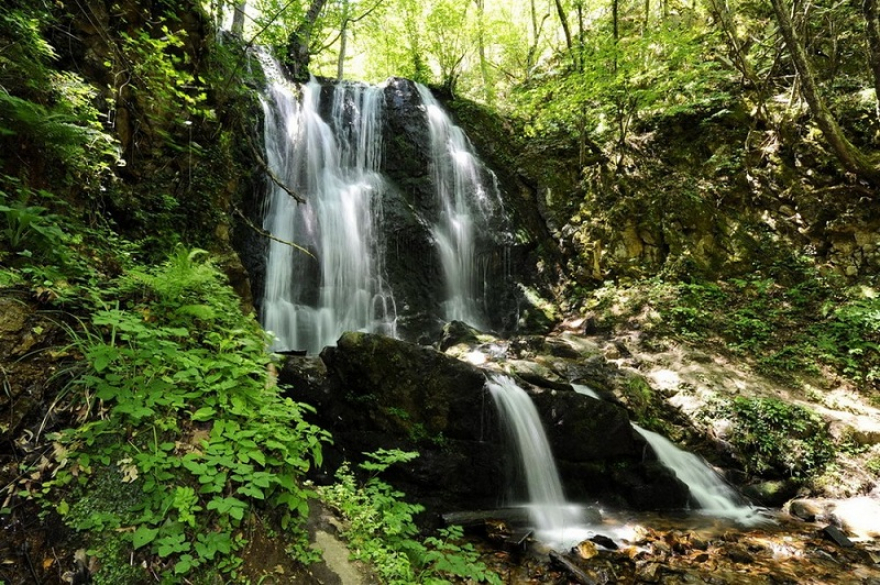
When she heard the murmur of water, Bianca needed only a few more steps to recognize her surroundings. This — this was the place from which inspiration had always come to her, even when it seemed absent. It was the waterfall, the place no child once dared to visit, because for their parents it was cursed ground where ominous events occurred. Yet she had always slipped away and gone there in secret. The other children lacked the courage to follow.
Only one child came after her, and together they splashed beneath the powerful rush of the waterfall that seemed to pour from the sky onto their bodies. Bianca remembered: they delighted in it, and she surrendered, rejoicing in the boy who stared persistently into her eyes, stirring in her that tender warmth she had claimed and kept ever since.
And here they were now, forty years later, Bianca and Tode, standing by the waterfall.
In a moment, they noticed a small but strange change. At the place where the water pooled calm and still, they saw tiny ripples. As if the water moved. Perhaps it was the wind? But there was no wind. Then what could be the cause? In the end it didn’t matter: they followed the ripples with their eyes, breathing deeply, feeling the freshness of the noisy water. As once, in the distant childhood.
In their eyes played the shadow of the same smile from long ago. The same complicity, repeated after forty years. Bianca turned her back to him, lifted her thick, curled hair, and reached for the zipper of the checkered dress she wore that day. The dress slid quickly down her legs and fell to the ground. She turned to Tode.
Tode loosened his belt and unbuttoned his trousers. He tried, hopping on one leg, to pull off the other pant leg, but the “latest trend in the fashion industry” resisted: Tode stumbled and fell into the grass. Bianca wasn’t shaken, but burst out laughing. Then she came closer and began tugging at the pant leg. Tode lay on his back, gazing at the sky, and when Bianca began pulling, he too started laughing. And Bianca continued giggling — her voice gurgled out, and with it all her worries seemed to flow away.
At last Tode freed himself from the trousers, and this time he offered her his hand. She took it, and he stood. Now both looked at the pooled water of the waterfall, then into each other’s eyes. They smiled, and turned again to the water. With small steps they waded in. Entering like that, they felt warmth on their skin: as if the water were heated and poured to warm their bodies. “Hey, warm water…” Bianca said. “Yes, can you believe it?” Tode’s eyes widened. “But how is it possible, this is a waterfall?” Bianca insisted.
An unusual sight: a woman and a man, nearly naked, knee‑deep in the pooled water beneath the waterfall.
Bianca removed the clips that kept her hair all tight, and be removing them, it was as if her entire being loosened up. And so — she surrendered to the moment. The moment from which everything had begun. Once again, she rejoiced like a child, but remembered also the old anxiety that once gnawed at her, that fear that her parents would appear and scold her for going again to the place everyone had to avoid. She exhaled, and felt all her worries drain away. In the end, wasn’t she the only culprit for not knowing how to surrender to the world? Wasn’t it by not surrendering that she missed life? Never surrender to nothing, in the end – miss everything.
No, nothing was missed, after all. Bianca looked into the same eyes that once gazed at her, eyes she could never resist. In the next moment, they were bathing beneath the powerful cascades. Water poured over them, washing from their bodies the layered worries, washing away the heavy poisons they had each absorbed in their chests for years along their separate paths.
Now they looked eye to eye, smiling. The waterfall roared.
“Do you think we were ever together?” he said. The answer came quickly.
“What if all along we were together, without knowing it?”
Author of the autofictional short story Back to the Waterfall is Mila T., one of five participants in the second creative writing workshop for autofictional stories, On the Natural Flow of Things, held in March and April of 2024. Editor of the story is Živko Grozdanoski, the workshop’s creator. The story was written in parallel with the stories A Word or Two, The hot seat and Ashram by Elena A., Bistra M. and Tea P. — the three other companions on the journey. The story was translated into English using Microsoft “Copilot” and redacted by Živko G.